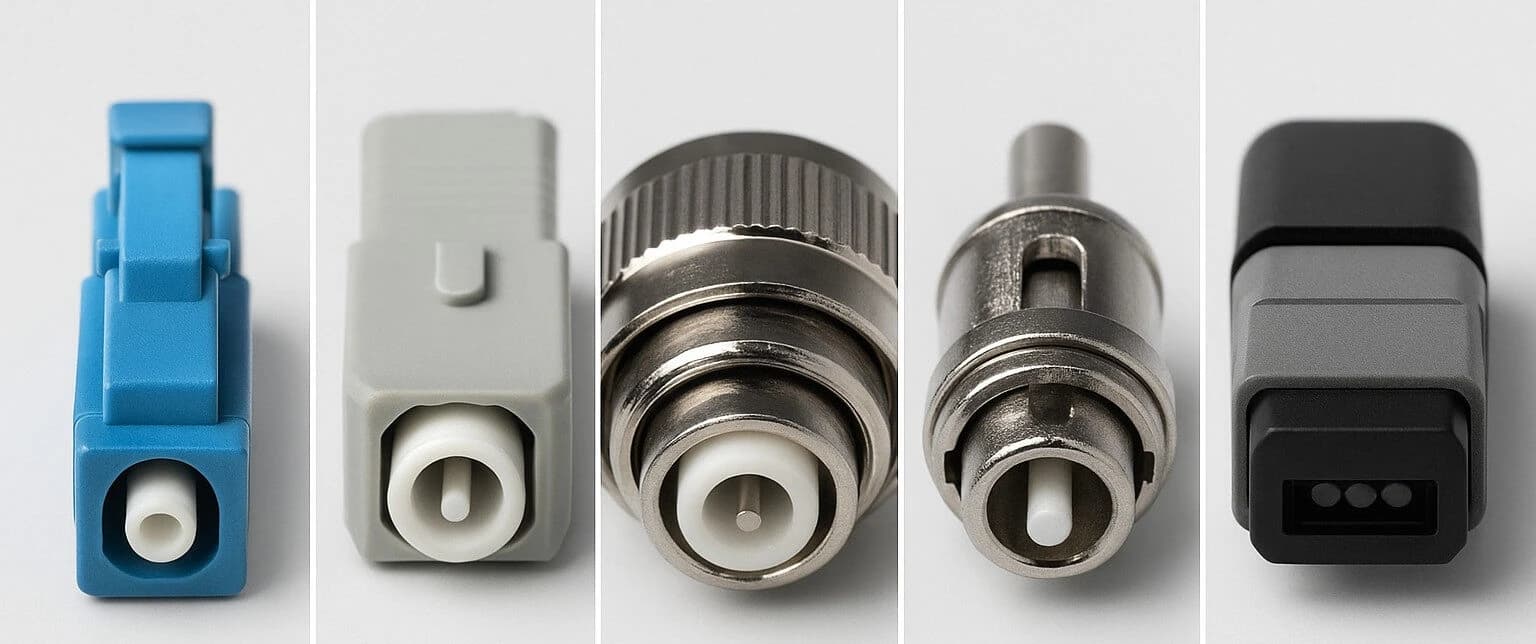
Fiber optic networks rely on precision and quality at every connection point, making optical connectors critical for ensuring minimal signal loss, reliable performance, and ease of maintenance. Choosing the right connector type and polishing method directly impacts network efficiency, especially in enterprise, telecom, and data center environments.
Common connector types include LC (Lucent Connector), SC (Subscriber Connector), ST (Straight Tip), and MPO/MPP (Multi-Fiber Push-On / Multi-Fiber Pull-Off).
LC connectors feature a small 1.25 mm ferrule with a push-pull design, making them ideal for high-density applications such as data centers, high-speed enterprise networks, and FTTH installations.
SC connectors use a 2.5 mm ferrule with a snap-in design that provides excellent repeatability and durability, making them suitable for telecom networks, passive optical networks, and metro fiber deployments.
ST connectors, also with a 2.5 mm ferrule, use a bayonet-style twist-on mechanism that is rugged and reliable, often applied in industrial networks, legacy campus networks, and long-distance fiber links.
MPO and MPP connectors support 12–24 fibers in a single connector and are designed for high-density backbone connections, commonly used in data centers and 40G/100G high-speed networking environments.
The polishing method of the connector affects insertion loss, return loss, and overall network performance. PC (Physical Contact) connectors have a standard polished tip where fibers physically touch and provide typical return loss of 35 dB, suitable for general-purpose networks. UPC (Ultra Physical Contact) connectors are optimized for minimal surface irregularities, offering return loss of 50 dB, making them ideal for high-speed digital systems and FTTH networks.
APC (Angled Physical Contact) connectors feature an 8° angled end-face to minimize back reflection, with return loss typically exceeding 60 dB, and are commonly used in analog systems, high-speed DWDM, and RF-over-fiber applications. Selecting the right connector requires considering the network type and speed, insertion and return loss requirements, mechanical compatibility with patch panels and transceivers, and future scalability. LC connectors and MPO solutions are preferred for high-density networks, while UPC or APC polishing ensures low-loss, high-performance links.